The Chief AI Officer (CAIO) plays a distinct role from the Chief Data Officer (CDO) and Chief Information Officer (CIO), though their responsibilities are deeply interconnected.
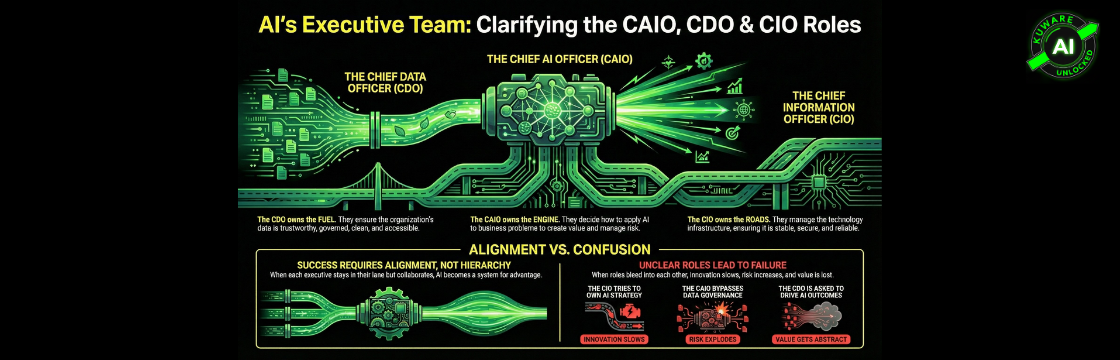
The most concise distinction is often described using an automotive metaphor: The CDO provides the fuel (data), while the CAIO focuses on the engine (AI models) to drive the vehicle.
The most concise distinction is often described using an automotive metaphor: The CDO provides the fuel (data), while the CAIO focuses on the engine (AI models) to drive the vehicle.
For organizations appointing a Chief AI Officer for the first time, this distinction becomes especially relevant during the CAIO’s first 90 days of learning, strategy formation, and execution planning.
CAIO vs. Chief Data Officer (CDO)
While these roles are symbiotic, they operate with different primary objectives, timelines, and skill sets.
1. Core Responsibilities
- The CDO (Governance & Quality): The CDO’s primary goal is to make data reliable, consistent, and accessible. They focus on data governance, privacy compliance, lineage, and lifecycle management. They ensure the organization has “clean, structured data”. These responsibilities reinforce why the CAIO is increasingly viewed as the executive accountable for enterprise-wide AI strategy, governance, and ethical oversight, not just model development.
- The CAIO (Application & Value): The CAIO focuses on how to apply that data to solve business problems. They oversee the building, implementation, and scaling of AI models (such as machine learning and neural networks) and ensure these models are unbiased and ethical.
2. Strategic Outlook
- CDO (Long-term Infrastructure): The CDO typically maintains a broad, long-term perspective, ensuring the architecture is in place to handle the evolving data landscape.
- CAIO (Dynamic Competitive Edge): The CAIO operates with a more dynamic, mid-term focus. Because AI evolves rapidly, they are tasked with identifying immediate solutions that provide a competitive advantage and keeping the organization ahead of the innovation curve.
3. Background and Skills
- CDO: Often comes from backgrounds in IT, business operations, or data management. Their expertise lies in organizational skills, data taxonomies, and regulatory landscapes.
- CAIO: Typically comes from a data science or machine learning background. They require a deep understanding of algorithms and best practices for model training, alongside the strategic acumen to integrate these tools into business processes.
CAIO vs. Chief Information Officer (CIO) & CTO
The distinction between the CAIO and traditional technology roles (CIO/CTO) centers on legacy management versus transformative integration.
1. Focus Areas
- The CIO: Traditionally creates and maintains the IT estate, managing legacy systems and general technology infrastructure.
- The CTO: Often focuses on new and emerging technologies broadly.
- The CAIO: Specializes in bridging the gap between these technical functions and business outcomes specifically for AI. They are responsible for “algorithmic safety,” ethical stewardship, and coordinating enterprise-wide AI integration, which goes beyond standard IT infrastructure.
2. Cross-Functional Integration
- CIOs often manage centralized IT departments.
- CAIOs are specifically mandated to prevent AI efforts from becoming siloed. They orchestrate collaboration across IT, legal, marketing, and HR to ensure AI solutions are integrated holistically rather than remaining isolated technical experiments.
The "Chief Internet Officer" Analogy
There is an ongoing debate regarding the longevity of the CAIO role compared to the established CIO/CDO positions. Some experts argue that the CAIO role acts as a temporary catalyst. Just as companies hired “Chief Internet Officers” in the 1990s who were eventually absorbed into the CIO role, the specific responsibilities of the CAIO may eventually be integrated into the broader technology infrastructure once AI becomes ubiquitous.
However, currently, the distinct need for a CAIO arises because AI introduces unique risks (hallucinations, bias) and transformative potential that require dedicated executive accountability, separate from general data management or IT operations.
