Let me start with an uncomfortable truth.
If you’re trying to justify AI investments using the same ROI formulas you use for software licenses or headcount reduction, you’re almost certainly making bad decisions.
Not because you’re doing the math wrong.
But because you’re measuring the wrong thing.
And right now, that mistake is quietly killing otherwise good AI initiatives inside a lot of businesses.
Everyone Wants AI ROI. Almost No One Knows How to Measure It
Global AI spending is expected to hit nearly $1 trillion a year by 2028. That number alone explains why boards, CFOs, and CEOs are all asking the same question:
“What’s the ROI?”
It sounds reasonable. Responsible, even.
But here’s the paradox I keep seeing in the real world:
Despite record AI spending, most AI projects fail.
Despite record AI spending, most AI projects fail.
Depending on whose research you trust, the failure rate is somewhere around 70–80%.
At first glance, that should terrify investors.
Instead, I think it should change how we think about AI entirely.
The 80% Failure Rate Isn’t a Red Flag. It’s a Clue.
If 80% of traditional IT projects failed, we’d shut the whole thing down.
But AI isn’t traditional IT.
AI behaves much more like R&D than software procurement.
You try things.
Most don’t work.
A few work incredibly well.
And the wins pay for the losses many times over.
Most don’t work.
A few work incredibly well.
And the wins pay for the losses many times over.
The real mistake isn’t that AI projects fail.
The mistake is expecting each AI project to justify itself in isolation.
That’s not how this game works.
AI needs to be managed like a portfolio, not a single bet.
And that means your ROI thinking has to change, too.
Your Biggest AI Costs Are Hiding in Plain Sight
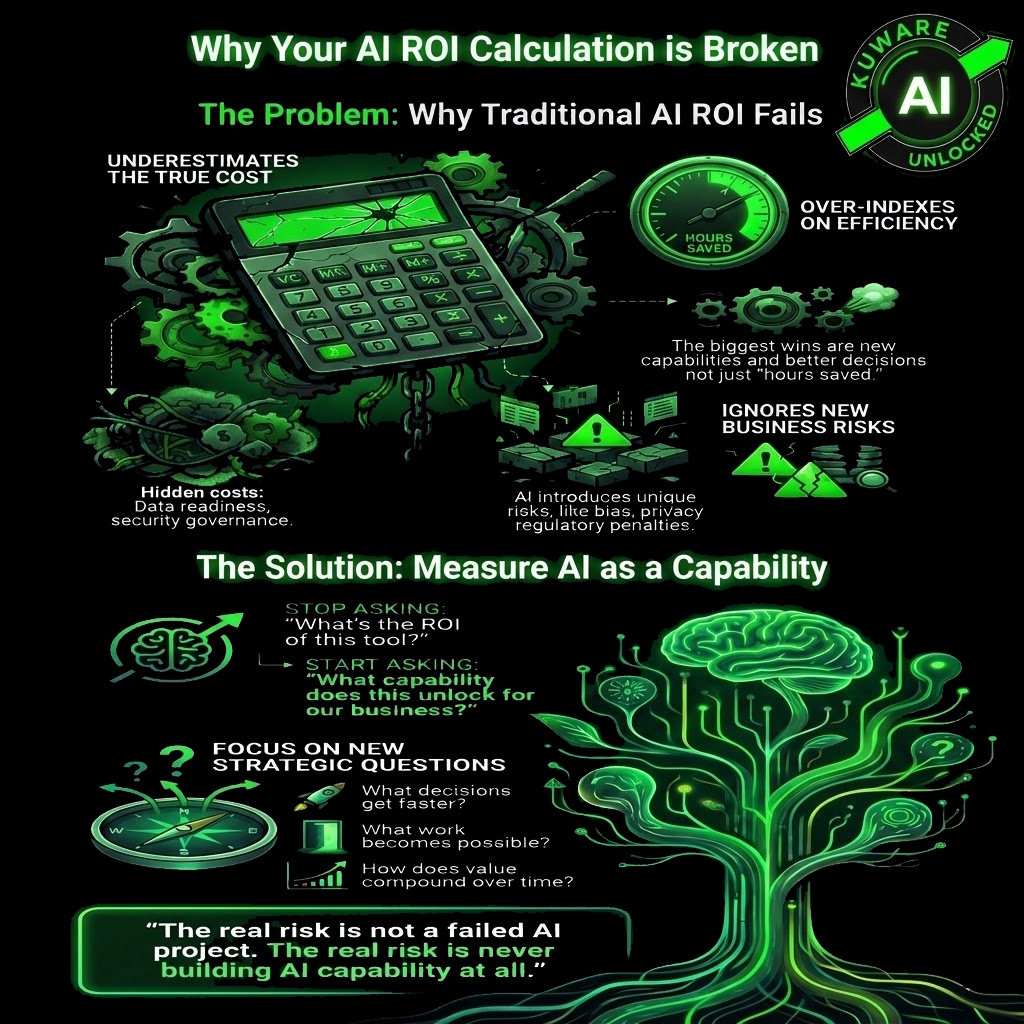
Another reason AI ROI calculations fall apart is that most of them dramatically underestimate cost.
Not because people are dishonest.
But because they’re blind to what actually costs money over time.
Here’s what almost never makes it into the spreadsheet.
Data Is Never “Ready”
Data cleanup isn’t a one-time task.
Neither is labeling, governance, validation, or quality control.
Neither is labeling, governance, validation, or quality control.
If your AI depends on data, congratulations — you’ve signed up for an ongoing operational expense.
Forever.
Models Drift. Reality Changes. Performance Degrades.
AI models don’t age gracefully.
Data changes. User behavior shifts. Edge cases multiply.
If you’re not actively monitoring and adjusting, performance erodes quietly. And so does ROI.
Pricing Gets Weird at Scale
Tokens. Credits. Usage tiers. Multipliers.
Many AI tools look cheap during pilots and get very expensive once adoption takes off.
That’s not a bug. That’s how pricing works.
Security and Governance Aren’t Optional
AI introduces new risks: data leakage, bias, hallucinations, and regulatory exposure.
Mitigating those risks costs money. Ignoring them costs more.
So no, AI doesn’t eliminate cost.
It moves cost.
The Most Valuable AI Benefits Don’t Fit in Excel
Here’s the single biggest reason ROI calculations fail.
They focus almost exclusively on efficiency.
Efficiency matters.
But it’s the least interesting part of AI.
But it’s the least interesting part of AI.
The real value shows up in places that don’t map cleanly to a spreadsheet:
- Better employee experience
- Faster decision cycles
- Higher quality insights
- More experimentation
- Increased adaptability
These benefits compound.
And compounding benefits look terrible in quarterly ROI models.
That doesn’t make them less real.
It just makes them harder to explain to finance teams.
It just makes them harder to explain to finance teams.
AI Also Creates New Risk (And That Has a Price Tag)
Another thing most ROI formulas conveniently ignore.
AI doesn’t just reduce risk.
It restructures it.
It restructures it.
Bias issues.
Privacy failures.
Regulatory penalties.
Bad decisions made faster than humans ever could.
Privacy failures.
Regulatory penalties.
Bad decisions made faster than humans ever could.
These risks aren’t theoretical. We’ve already seen projects turn from “flagship innovation” into expensive liabilities.
If your ROI model doesn’t account for risk introduced, it’s lying to you.
You’re Measuring “Productivity” Completely Wrong
This one drives me crazy.
The most common AI ROI math looks like this:
Hours saved × salary = ROI
That’s a tactical view.
And it misses the biggest value entirely.
AI often enables work that simply would never have been done before.
Analysis that would’ve taken months.
Personalization that was impossible at scale.
Insights that no team had the bandwidth to produce.
Personalization that was impossible at scale.
Insights that no team had the bandwidth to produce.
The value isn’t the time saved.
The value is the decision that now exists.
I like to think of this as digital yield.
AI doesn’t just save time.
It creates new output.
It creates new output.
And that output is where real competitive advantage lives.
Where Simple ROI Calculators Still Matter
Now, let me be clear.
I’m not anti-ROI math.
Simple calculations absolutely have a place.
Estimating:
- hours saved
- cost per task
- resource reduction
It is a perfectly good starting point.
That’s exactly why we built a simple AI ROI calculator based on time and resource savings:
It’s meant to help you:
- prioritize ideas
- compare opportunities
- sanity-check assumptions
It is not meant to be the final word on AI value.
Complex AI initiatives demand broader thinking.
A Better Question Than “What’s the ROI?”
If there’s one thing I’d change in boardrooms tomorrow, it’s this.
Stop asking:
“What’s the ROI of this AI tool?”
Start asking:
- What capability does this unlock?
- What decisions get faster or better?
- What work becomes possible for the first time?
- What risks are reduced or introduced?
- How does this compound over time?
AI isn’t a line item.
It’s a capability curve.
And the biggest risk isn’t that an AI project fails.
It’s that you never build the capability at all.
